
Acupressure Mat Benefits: What the Research Really Says
Search "acupressure mat benefits" and you will find a lot of confident promises, from better circulation to fat burning. This page does something more useful: it sets out what users genuinely report, cites the real research with its sample sizes, and tells you plainly who should check with a doctor first. If you want to see how people fit a mat into their evening, our acupressure mat before bed guide covers the sleep angle, and the SpikeRest mat itself is the product we build this around.
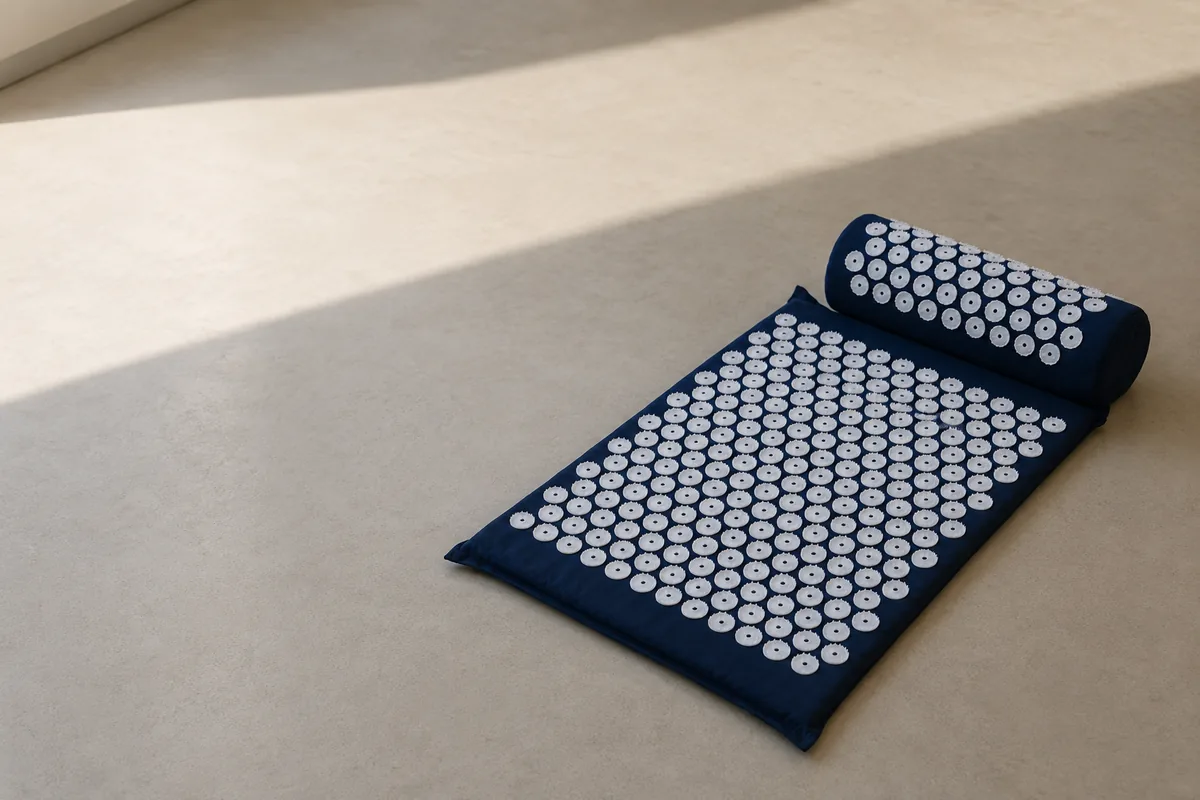
What an acupressure mat actually does
This split — a real subjective effect without a matching physiological one — shows up again and again in the literature. It is worth taking seriously in both directions. It means the relaxing feeling people describe is not imaginary or dishonest; a lot of participants genuinely feel better. It also means you should be skeptical of anyone selling a mat as a cure for a specific condition. Below are the studies we could actually verify, each with its size and its limits, so you can judge for yourself.
The research, honestly summarized
A 2011 exploratory study on a "bed of nails" mat (n = 32) reported that participants felt more relaxed and showed a measurable shift in heart-rate variability during use. It looked at one hormonal marker, salivary cortisol, which stayed level over the session. The authors framed it as exploratory, meaning it points a direction rather than proving an effect.
A 2012 pair of randomized controlled pilot studies (Hohmann et al., total n = 42) tested a mechanical needle-stimulation pad in people with chronic neck and lower-back discomfort and reported lower pain-intensity ratings after two weeks of self-use. Crucially, the authors called these pilot results and said larger trials were needed before drawing conclusions — so this is a promising signal, not a settled finding.
A 2021 randomized controlled study (n = 44) in Applied Sciences added an acupressure mat to a supervised exercise program for chronic low-back discomfort. Both the mat group and the exercise-only group improved over six months; a couple of self-reported measures moved more in the mat group. Because both groups got better, the study cannot cleanly separate the mat's contribution from the exercise.
A 2024 three-week relaxation-training study had beginners practice either with an acupressure mat or with no tool at all. Perceived stress and well-being improved — but improvements appeared in both groups, over three weeks of practice. The takeaway the authors drew: the mat gave people a reliable way to reach that relaxed state, night after night.
Exploratory 'bed of nails' study: participants reported more relaxation and a measurable shift in heart-rate variability during use
Two randomized pilot studies of a needle-stimulation pad reported lower pain-intensity ratings after two weeks — the authors explicitly called for larger trials
— Hohmann et al., Evidence-Based Complementary and Alternative Medicine, 2012
Acupressure mat plus exercise vs exercise alone: both groups improved over six months, so the mat's independent effect is unclear
— Applied Sciences (MDPI), randomized controlled study, 2021
of relaxation practice lowered perceived stress and improved well-being; blood pressure, heart rate and pain thresholds stayed unchanged, and the gains appeared with or without the mat
— Kisker et al., Applied Psychology: Health and Well-Being, 2024
What we know about acupressure mats
| What the evidence reasonably supports |
|---|
| People often report feeling more relaxed after a session |
| A warm, tingling skin sensation is commonly described |
| Many use them as an evening wind-down cue |
| No serious adverse events were reported in the small trials |
| Short pilot studies show promising signals on pain-intensity ratings |
If you take one thing from this table, let it be this: a mat is a genuinely pleasant, low-cost relaxation habit, and that is a fair reason to own one. It is a wellness product rather than a medical device, and used as one it earns its place in an evening routine.
What users actually describe
Across our own buyer photos and reviews, the language repeats. People say the first thirty to sixty seconds are sharp — "intense at first, that's normal" is almost a refrain — and then it settles into warmth. Many describe using it to decompress after work or before bed. Some simply say it forces them to lie still and breathe for ten minutes, which may be much of the point. We report these as what people describe, not as claims about your body. You can read buyer experiences on our reviews page, and if you are new to the sensation, the first session guide sets realistic expectations.
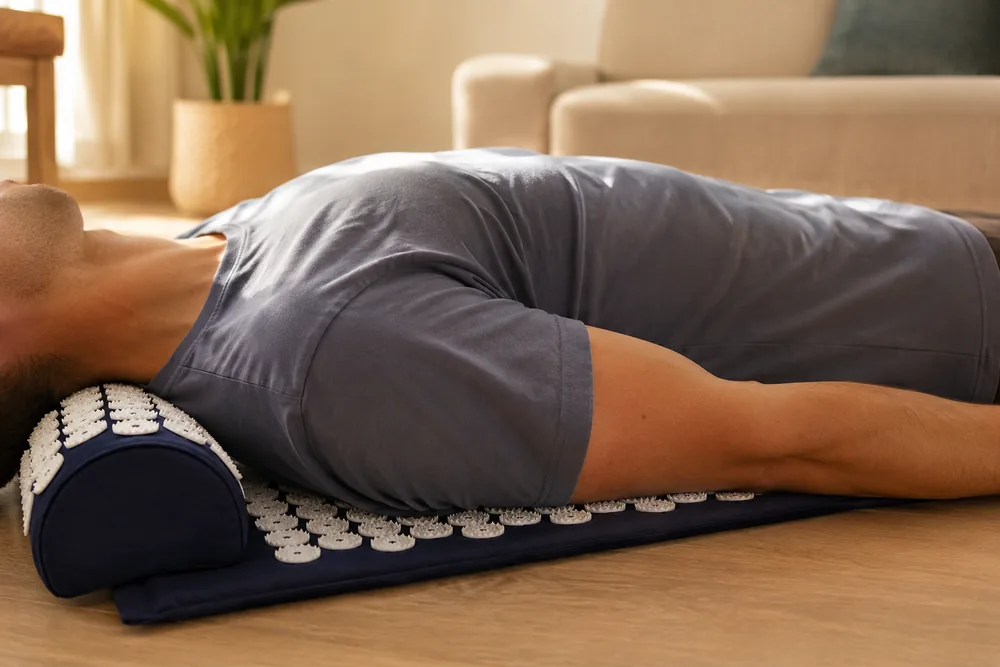
Acupressure mats and sleep
The appeal is easy to understand — a few quiet minutes lying still, breathing, away from screens, is a reasonable way to signal to yourself that the day is ending. In the 2024 training study, sleep-quality ratings did improve for people practicing relaxation, but the improvement was not unique to the mat group. So if a mat helps you actually carve out that wind-down window, it may be doing useful work as a habit anchor even without a special physiological mechanism. Our before-bed routine guide and how-to-use guide both go deeper on building that routine.
Who should avoid acupressure mats
Be cautious, or check with a clinician before starting, if any of these apply to you:
- Pregnancy — talk to your doctor before use.
- Blood thinners or bleeding disorders — pressure on the skin can cause bruising more easily.
- Broken, infected, sunburned, or irritated skin — wait until it has healed.
- Reduced skin sensation (for example from diabetes or peripheral neuropathy) — you may not feel when pressure is too much.
- Heart conditions or a pacemaker — and note that some foot mats contain small magnets; if that is a concern for you, ask your doctor.
Wellness disclaimer: SpikeRest mats are wellness products, not medical devices. They are not intended to diagnose, treat, cure, or prevent any condition. If you have a medical condition, are pregnant, or take blood thinners, talk to your doctor before use.
How we keep this page honest. Every study cited above was verified individually — title, year, sample size, and its own stated limits — as part of our how we test process, rather than repeated from other product pages. When a study called itself a pilot, we say pilot. When both groups in a trial improved, we say so. Our curator Maya Ellison also logs her own timed sessions on each mat color, and every figure we publish is one she measured herself. That is the standard we hold this page to, and it is why you can trust the specs you order against.
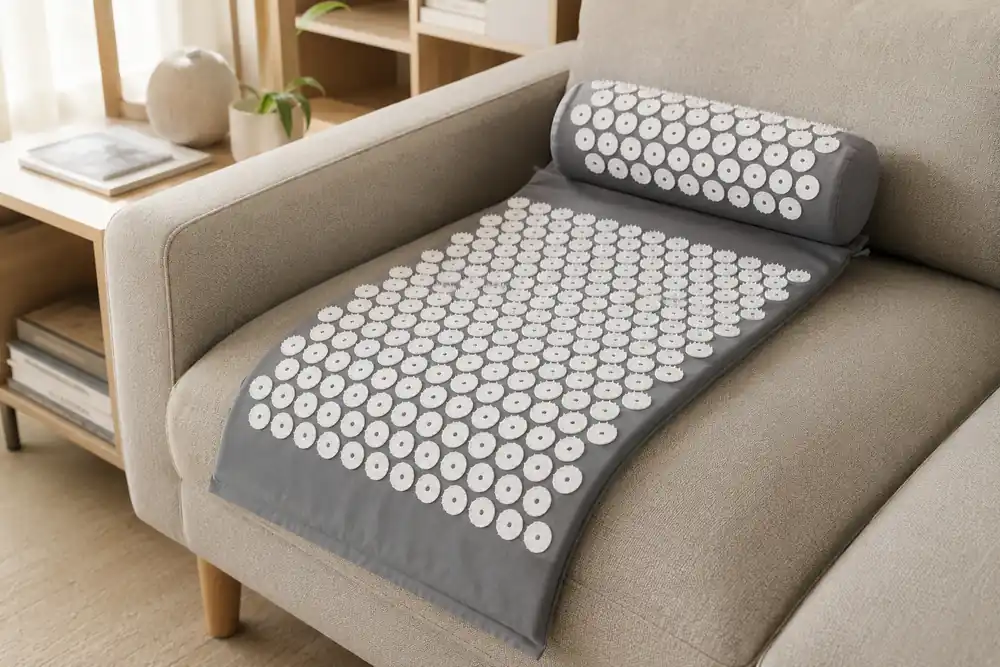
How to get the most from your mat
A few practical pointers that follow directly from the evidence — since the reliable effect is subjective relaxation, everything below is about making the ritual easy and repeatable:
- Pick a fixed cue. After brushing your teeth, or right after work. Tying the mat to an existing habit makes it stick.
- Start short. Five to ten minutes is plenty at first. A session you will do again beats one you dread.
- Breathe slowly. The first minute is the intense part; slow breathing is what carries most people through to the warm phase.
- Use a shirt or socks to dial intensity. A thin layer softens the points; bare skin turns it up.
- Keep it in view. A mat in a drawer gets forgotten. Leave it where you will see it at wind-down time.
If you are still comparing options and price points before committing, our best acupressure mat comparison is candid about where the SpikeRest set wins (price and value) and where premium brands differ. You can also use a full-size mat for your feet — see the foot acupressure mat guide for standing use.
Who wrote this

Maya Ellison · Wellness Product Tester & Curator, SpikeRest
Maya tests every mat on her own evening routines — timed sessions, one color at a time — and turns down more references than she approves. She verified each study cited on this page individually before it was published.
Reviewed and updated July 4, 2026. See how we test and our story.
Acupressure mat benefits FAQ
What does an acupressure mat actually do?
It delivers a reliable relaxation effect. Research consistently shows people report feeling more relaxed and less stressed after using one — that subjective effect is fairly reliable. What studies have not shown is a clear physiological change: measures like blood pressure, heart rate, and cortisol often stay the same. So a mat is a well-documented relaxation tool and a wellness product, and strong medical claims are a separate matter the evidence does not support.
What are the main benefits people report from acupressure mats?
The most commonly reported experiences are a feeling of relaxation, a warm tingling sensation on the skin, and a sense of winding down, which is why many people use them in the evening. Some describe them as part of a bedtime routine. These are self-reported, subjective experiences rather than proven medical outcomes, and they vary a lot from person to person.
Can an acupressure mat help with sleep?
Many people use acupressure mats as part of a wind-down routine before bed and describe feeling calmer afterward. Research on sleep specifically is limited: one three-week study found sleep quality ratings improved for people practicing relaxation, but improvements appeared whether or not a mat was used. So a mat may be a useful cue for winding down, but it is not a proven sleep treatment.
Who should not use an acupressure mat?
Avoid it, or check with your doctor first, if you are pregnant, take blood thinners or other anticoagulants, have broken, infected, or irritated skin, have reduced skin sensation (for example from diabetes or neuropathy), or have a heart condition or a pacemaker. Acupressure mats are wellness products, not medical devices, and they are not a substitute for medical care.