
· Maya Ellison
Acupressure Mat for Headaches: What It Can and Cannot Do
Search "acupressure mat for headaches" and you will find pages promising relief in ten minutes. This is not one of them. SpikeRest sells a relaxation tool, and we describe it as exactly that: firm, distributed point pressure on the muscles between your skull and your shoulder blades at the end of the day. This guide covers the part that is specific to the head and neck — where the points go, which piece of the set does the work, and how long to stay. One thing before anything else: if your headaches are persistent, unusual, or getting worse, the next step is a doctor, not a mat.
The only headache this guide is about
Most people who type this search know the feeling: a dull pressure at the base of the skull or across the temples late in the day, after hours hunched over a laptop. The neck and shoulder muscles have been holding one position all that time, and the head is where you notice it. That muscular pattern is where a mat has a role — not on the headache itself, but on the tight neck and shoulders underneath it.
Migraine is not that. Migraine is a neurological condition with its own diagnosis and its own treatments, and a foam mat with plastic spikes is not one of them. SpikeRest mats are wellness products, not medical devices: they are not intended to diagnose, treat, cure, or prevent migraine or any other condition. If your headaches come with aura, nausea, or sensitivity to light, or are frequent enough to shape your week, that conversation belongs with a doctor.
Why the neck is where a mat earns its place
Lie back on the points and, after the first sharp minute, most people feel a spreading warmth across the area in contact — the arc our first session guide describes minute by minute. What matters here is aim: the compact format covers one zone per session, so a neck session starts with putting the points where the neck actually is.
Two randomized pilot studies of a needle stimulation pad in chronic neck and lower back discomfort reported lower pain intensity after two weeks, and the authors called for larger trials
— Hohmann et al., Evidence-Based Complementary and Alternative Medicine, 2012
Note what that study is and is not: a small pilot on neck and back discomfort, not a headache trial. We cite it because it is the closest research to this zone, and our acupressure mat benefits page walks through every study we rely on, limits included.
Position 1: the bolster pillow under the curve of the neck
- Set the mat on a firm, flat surface — floor or firm mattress.
- Place the bolster across the top edge of the mat, spikes up, where your neck will land.
- Lower yourself in stages: sit, roll back onto your forearms, shoulders down, neck onto the curve last.
- Let the head rest back gently. The points belong on the muscles of the neck, not on the skull. If you feel pressure on bone, slide the bolster a touch lower.
Keep a thin shirt between skin and points for the first sessions — the shirt-first rule from our beginner guide applies doubly on the neck. The bolster comes with the Mat + Pillow Set; with the mat alone, a rolled towel under the neck gives a gentler version of the same shape.
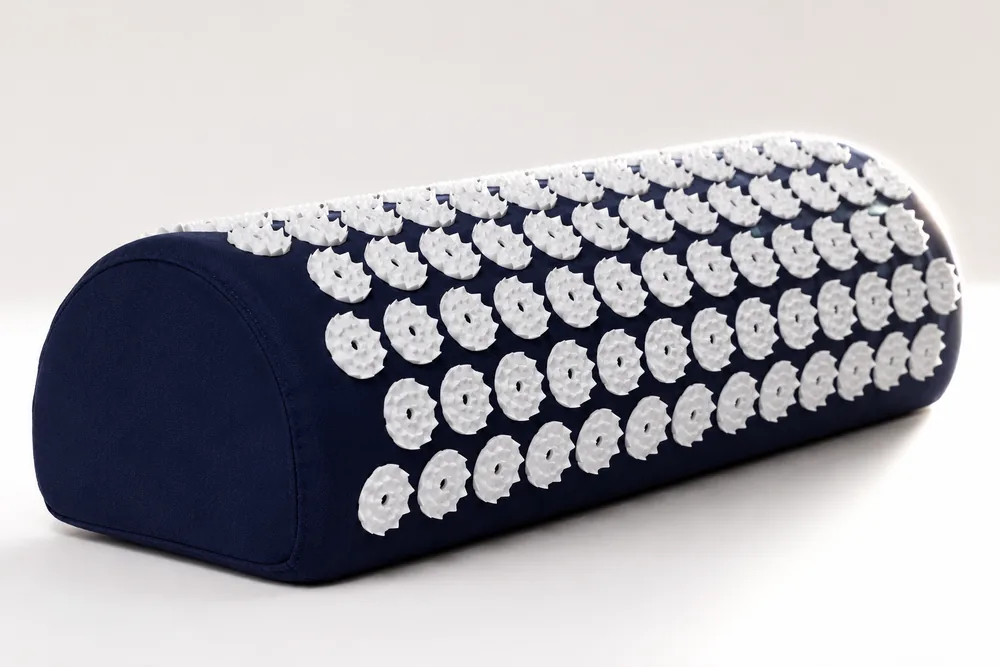
SpikeRest bolster pillow — a half-cylinder sized to slot under the curve of the neck
— SpikeRest product specs, 2026
Position 2: shoulders and upper back on the top edge of the mat
This is the mirror image of the rule in our lower back positioning guide, where the bottom hem lines up with the pelvis. Same logic, opposite reference point. At 26 x 15.7 in (66 x 40 cm) the mat covers from the shoulders to the mid back in this position — the full territory of a desk-day slump.
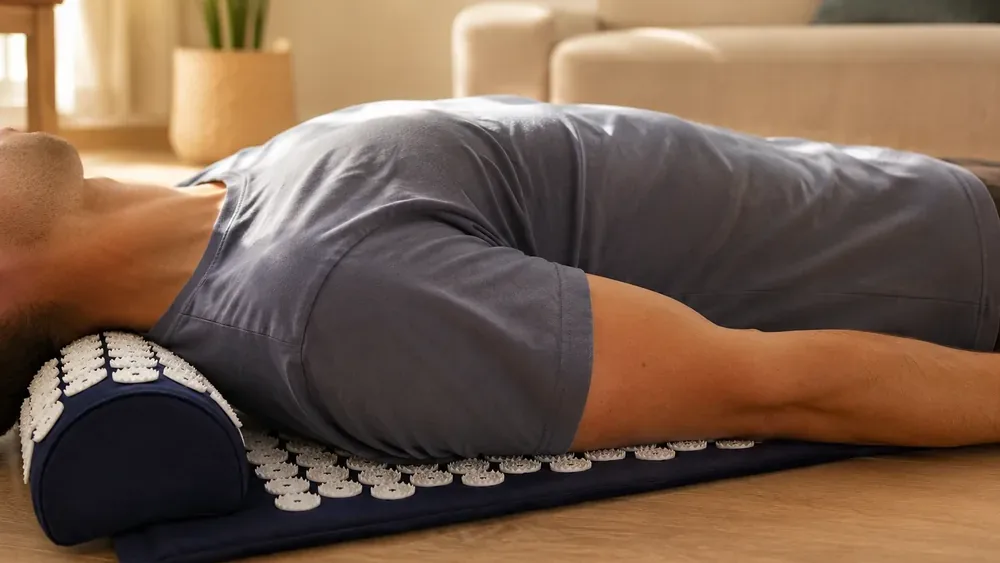
You can combine the two: bolster under the neck, shoulders on the mat's top rows. That is the position in the photo at the top of this page. Keep the knees bent, feet flat — a hollow lower back tips the shoulders up and thins the contact you came for.
| Setup | What it reaches | Start here if |
|---|---|---|
| Bolster under the neck | The band of muscle between skull and shoulders | The tightness sits high, near the hairline |
| Top edge of mat at the shoulder line | Shoulders and the area between the shoulder blades | The tightness sits lower than the neck |
| Mat draped over a chair back | Upper back, at lower intensity, sitting up | Lying down is not realistic in your day |
The seated chair version is covered, with the standing and full-back positions, in the how to use guide — it is the low-intensity fallback for an office afternoon.
How long a neck session lasts, and when to schedule it
Set a timer — time is hard to judge from inside a session. Come off earlier if the sensation stays sharp instead of fading toward warmth; that is the signal to keep the shirt on a few more sessions or to swap the bolster for the rolled towel.
As for the clock: an evening session pairs the muscle work with the moment your shoulders finally come down anyway. Our before bed routine builds the full sequence, so we will not repeat it here. The short version: mat on the floor beside the bed, bolster under the neck, lights already low.
What the research shows — and where it stops
An exploratory study on a spiked mat reported more relaxation during use, with a measurable shift in heart-rate variability during the session
A relaxation-training study had beginners practice with or without an acupressure mat; perceived stress and well-being improved in both groups across three weeks of practice
— Kisker et al., Applied Psychology: Health and Well-Being, 2024
Read together, the picture is consistent: lying on the points is a relaxation practice, and relaxation practices measurably reduce perceived stress. That mechanism — relaxed neck and shoulder muscles instead of clenched ones — is as far as the evidence goes. Our benefits page keeps the full study list, along with the people who should ask a doctor before using a spike mat at all.
Why this page never promises headache relief. A claim like "gets rid of headaches" would need a headache trial behind it, and there is none for this product category. What we stand behind is narrower and real: a timed session puts firm, distributed pressure on the exact muscles a desk day stiffens, and users consistently describe coming off it looser than they lay down. See how we test.
When a headache needs a doctor, not a mat
See a doctor promptly if your headache:
- Arrived suddenly and severely — a "worst headache of my life" onset is an emergency.
- Followed a fall, a crash, or any blow to the head, even a minor-seeming one.
- Comes with fever and a stiff neck, a rash, confusion, or drowsiness.
- Comes with vision changes, weakness, numbness, or trouble speaking.
- Is new after age 50, or has changed its pattern — more frequent, differently located, or waking you at night.
- Persists for days or keeps returning despite rest — persistent or unusual headaches deserve a professional look.
None of this means a mat caused anything. It means your question is a medical one, and the routine on this page can wait until a professional has answered it.
Wellness disclaimer: SpikeRest mats are wellness products, not medical devices. They are not intended to diagnose, treat, cure, or prevent any condition, including tension headaches or migraine. If you are pregnant, take blood thinners, or have a medical condition, talk to your doctor before use.
Neck and headache FAQ
Can an acupressure mat make a headache go away?
An acupressure mat is a relaxation tool, not a headache treatment. What it does is press hundreds of plastic points into the muscles of your neck, shoulders and upper back — the zone where everyday tension builds. If a headache persists, keeps returning, or feels unusual, see a doctor.
Does an acupressure mat help with migraines?
Migraine is a medical condition, and SpikeRest mats are wellness products, not medical devices. They are not intended to diagnose, treat, cure, or prevent migraine or any other condition. For migraine, the right person to ask is a doctor, not a mat.
Where does the bolster pillow go for a neck session?
Under the curve of your neck, so the points reach the muscles between skull and shoulders while your head keeps support. At 14.6 x 5.9 x 3.9 in (37 x 15 x 10 cm), the half-cylinder slots into that curve; let the head rest back gently rather than pressing the skull into the points.
How long should a neck session last?
Start at two minutes, as for any new zone, and build toward 15 to 20 minutes over a week or two as the sensation settles from sharp to warm. Set a timer.
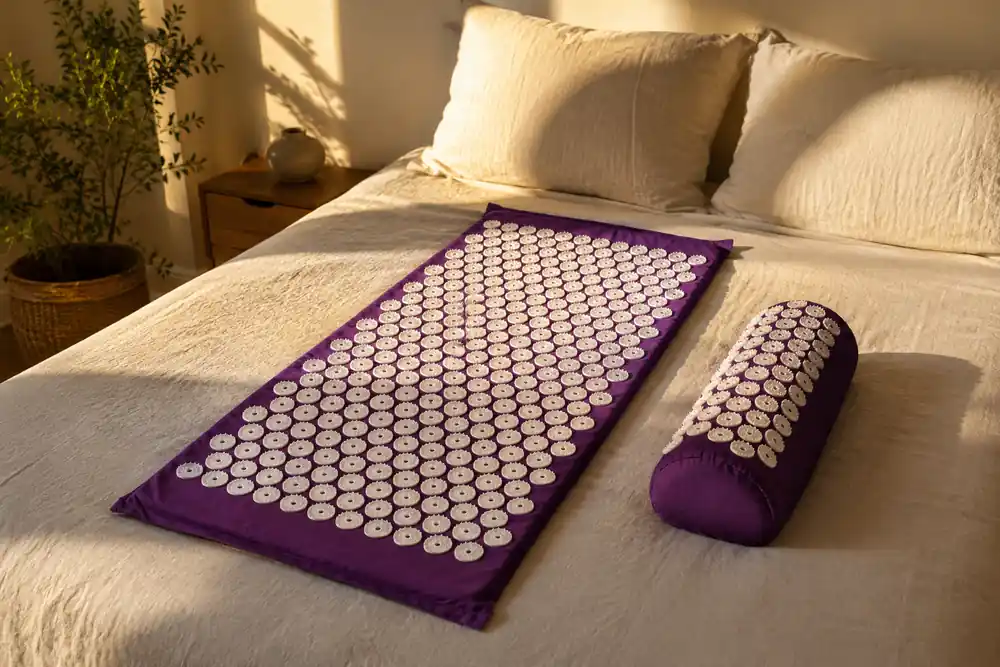
For the studies and who should avoid spike mats, see our acupressure mat benefits page; for the full wind-down, acupressure mat before bed; for the lumbar version of the positioning logic, acupressure mat for lower back pain. The SpikeRest mat starts at $34.95, and the Mat + Pillow Set at $44.95 adds the bolster this page is built around — free shipping in 6 to 10 business days.

Maya Ellison · Wellness Product Tester & Curator, SpikeRest
Maya tests every mat on her own evening routines, timed sessions, one color at a time. For this guide she timed two weeks of neck sessions with the bolster to settle the placement advice.
Reviewed and updated August 20, 2026. See how we test and our story. Read more on the SpikeRest blog.