
· Maya Ellison
How to Clean an Acupressure Mat Without Harming the Spikes
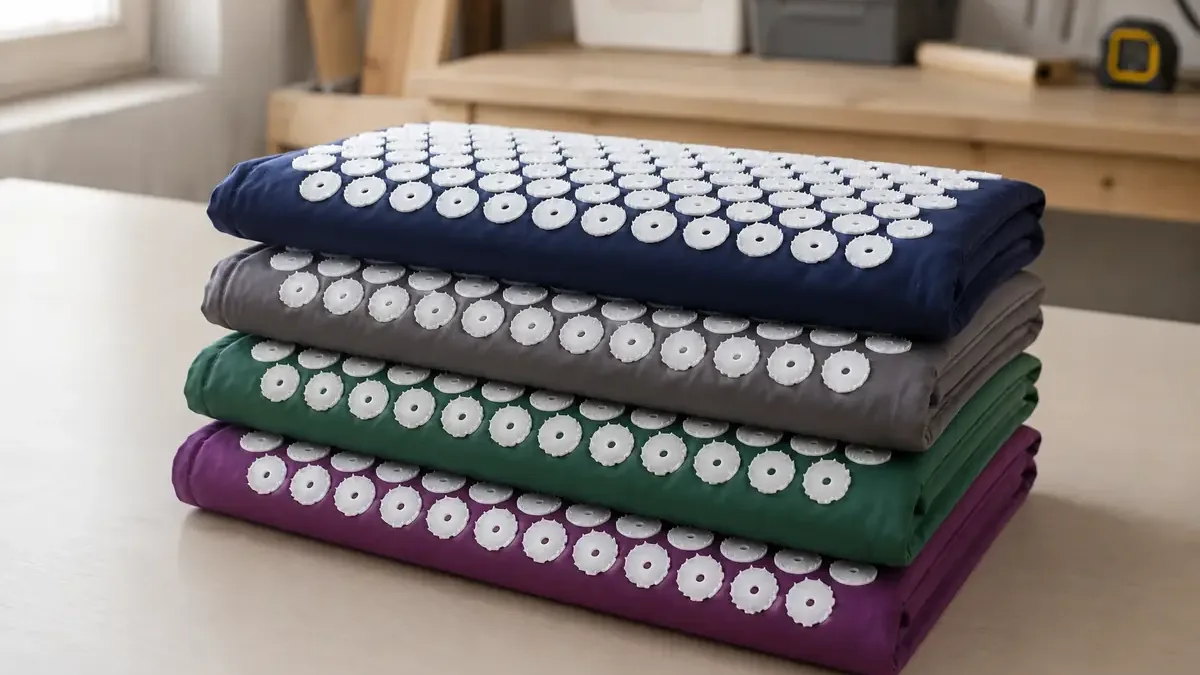
An acupressure mat is one of the few things you own that lives on the floor and touches bare skin, often in the same evening. That combination is what decides how you clean it. The SpikeRest mat is built to come apart — a fabric cover with a velcro closure, a removable foam insert, and the plastic pyramid-point disks underneath — and only one of those three belongs anywhere near a washing machine. This guide covers the order to work in, what to wipe rather than soak, and where to keep the mat between sessions. If you are still building the routine itself, our how to use an acupressure mat guide covers the sessions; this one covers everything that happens afterwards. The SpikeRest mat and set starts at $34.95.
What actually collects on an acupressure mat
What makes a spike mat different from a flat mat is texture. Lift a flat surface, shake it, and most of what landed on it falls off. A surface covered in plastic disks holds on, because every disk creates a sheltered pocket where it meets the fabric, and another one at the hole in its middle. That is why a mat that looks perfectly clean at arm's length can feel faintly gritty when you run a palm across it.
Two habits decide how fast this builds up. Using the mat through a thin shirt puts a layer of cotton between your skin and the surface. Standing on it barefoot, the routine covered in our foot acupressure mat guide, brings in whatever the floor had on it. Neither is a reason to change how you use the mat — they just tell you which sessions are worth cleaning up after.
Start by taking the cover off
This separation is the whole reason the mat is straightforward to look after. The spec is plain enough: a fabric cover with a velcro closure over a removable foam insert, with plastic pyramid-point disks underneath. Undo the velcro, ease the insert out, and the cover behaves like any other piece of household fabric.
Do it on a table rather than on the floor, and do it before any water enters the picture. Once the parts are apart it becomes impossible to soak the piece that should not be soaked, which is the mistake that does lasting harm. The bolster pillow included in the Set uses the same construction in a smaller, rounder shape, so it comes apart in exactly the same way.
Washing the fabric cover
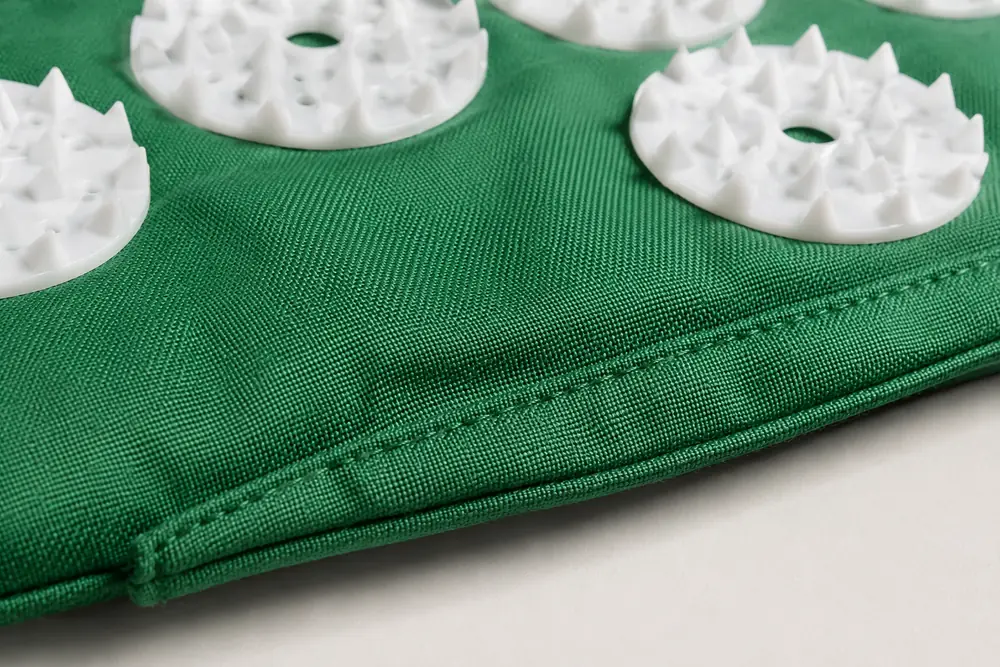
Turn the cover inside out and wash it by itself rather than adding it to a load of towels — it is a light piece of fabric and gains nothing from the abrasion. A mild detergent is enough, and there is no call for a specialist product: the part that needs cleaning is fabric.
Our how we test routine puts covers through repeated wash cycles deliberately, then checks the velcro grip and the seams afterwards, because a cover that survives one wash and gives up on the fifth is not really washable. If you would rather be gentler, hand-washing the cover does the same job. The only firm rule is that the insert and the disks are part of neither.
SpikeRest test routine re-checks velcro grip, stitching and spike-disk retention after the cover has been through the wash
— SpikeRest how we test, 2026
Wiping the spike disks and the foam insert
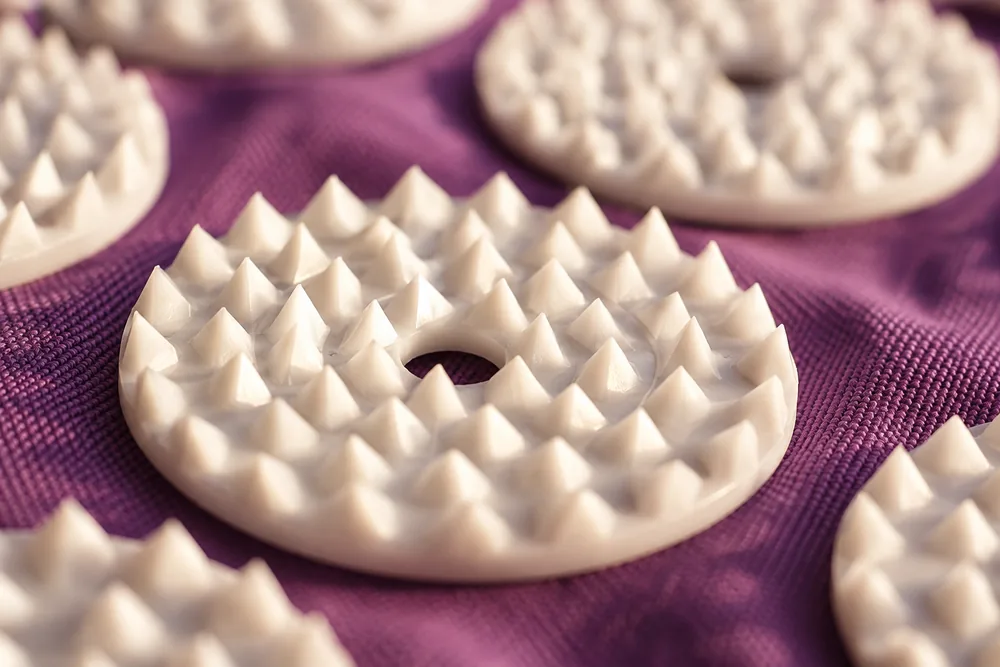
Direction matters more here than it sounds. The disks are laid out in rows, and dragging a cloth across them catches on every point in turn, while running it along a row lets the cloth reach down to the fabric between the bases. Wring the cloth out until it is barely damp — the aim is to lift what is sitting there, not to wet the assembly.
For the small hole at the centre of each disk, a cotton bud or a twisted corner of the cloth reaches what a flat wipe cannot. There is no need to work through every disk in one sitting either. The area under your shoulders and lower back sees the most contact, and that is the stretch worth a pass. Let both the disks and the foam sit in open air afterwards. Closing a velcro seam over anything still damp is what turns a clean mat into a stale-smelling one.
Drying, and why it decides how the velcro ages
Air-drying is not a line written to fill out a care label. It is the step our own test routine is built around. When we inspect a cover after wash cycles, we are looking for three things in particular: fraying at the seams, stitching that has loosened, and a velcro closure that no longer holds as firmly as it did. Those three share a cause more often than not, and it is heat or trapped moisture rather than the washing itself.
Lay the cover flat rather than hanging it from a line by one corner, which stretches the fabric wherever the clip bites. Give the foam insert and the disks the same open-air treatment on a towel. And resist the urge to hurry any of it along on a radiator: the disks are plastic and the insert is foam, and open air suits both far better than a heat source does.
The bolster pillow follows the same routine
At 14.6 x 5.9 x 3.9 in (37 x 15 x 10 cm) the bolster is the piece that sits under your neck, which puts it in contact with hair and scalp rather than a shirted back. In practice that makes it the part of the set many people wash more often than the mat itself, even though it spends fewer minutes in use.
Its rounder shape is the only thing that changes the handling: slide the insert out along the length rather than trying to work it through the opening sideways, and re-fit it the same way. If you use the bolster under your knees rather than your neck — the position we recommend in our lower back positioning guide — it stays clean noticeably longer, since the contact there is with clothing rather than skin.
Where to keep the mat between sessions
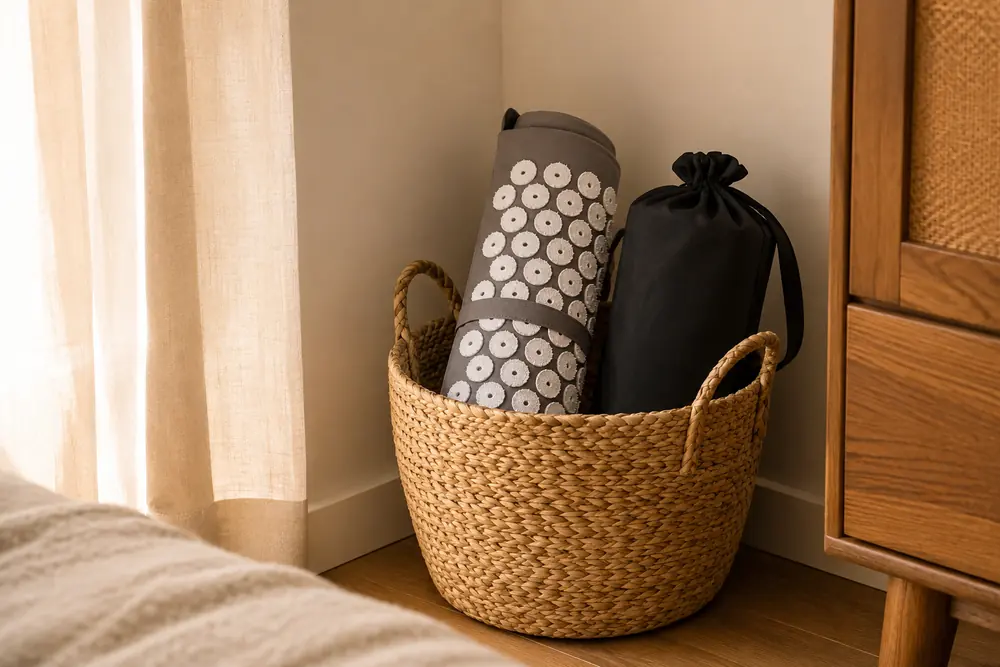
The easiest cleaning is the dust that never lands. A mat left face-up on the floor collects everything that settles in a room over a week; the same mat rolled and dropped into a basket collects very little of it. This is also where the compact format earns its keep — at 26 x 15.7 in (66 x 40 cm) it rolls small enough to sit in a corner basket or slide into the carry bag that comes with the complete set.
SpikeRest mat surface — a compact format that rolls into its own carry bag for storage between sessions
— SpikeRest product specs, 2026
Rolling and folding both work. Our own product photographs show the mat rolled with the disks facing outward, which is how it slides into the bag and how it sits in a basket without the points pressing into one another. Whichever you settle on, keep it out of direct sunlight and off a radiator, for the same reason you did not dry it there.
What to check while the cover is off
It is the same short list our curator works through on every batch:
- Disk retention. The disks should stay firmly attached to their backing. This is the main one — a disk working loose is the way a spike mat degrades.
- Seams and stitching. Run a thumb along the hemmed edge and look for fraying or a line of stitching that has opened.
- The velcro strip. It should close with a firm press and stay closed. Pick any lint out of the hooks while the cover is open — that is usually all a tired-feeling closure needs.
None of it takes long, and the cover is already off. Every SpikeRest set is covered by a 30-day money-back guarantee we handle ourselves, so anything that does look wrong has a direct route.
What we noticed doing this repeatedly. As part of our how we test process, our curator Maya Ellison takes covers off and puts them back on across all four colors — Navy Blue, Gray, Green and Purple — and washes them between rounds rather than only at the end. Two things came out of that. The velcro closure is the component that tells you first when a cover has been dried too aggressively, well before the fabric shows anything. And the disks themselves needed far less attention than expected: a wipe along the rows did more than any scrubbing, because what collects on a spike mat sits around the bases rather than on the points.
Wellness disclaimer: SpikeRest mats are wellness products, not medical devices. If you have a medical condition, are pregnant, or take blood thinners, talk to your doctor before use. If your skin is broken or irritated where the mat would sit, that is a conversation for your doctor rather than a cleaning question.
With the upkeep settled, the rest is just using it: our first acupressure session guide walks through what the sensation actually feels like, and our acupressure mat benefits page covers what the research does and does not show. You can also read what buyers say about the set on our reviews page.

Maya Ellison · Wellness Product Tester & Curator, SpikeRest
Maya tests every mat on her own evening routines — timed sessions, one color at a time — and turns down more references than she approves. She wrote this care routine from the wash-and-inspect cycles she runs on every batch.
Reviewed and updated August 10, 2026. See how we test and our story. Read more on the SpikeRest blog.